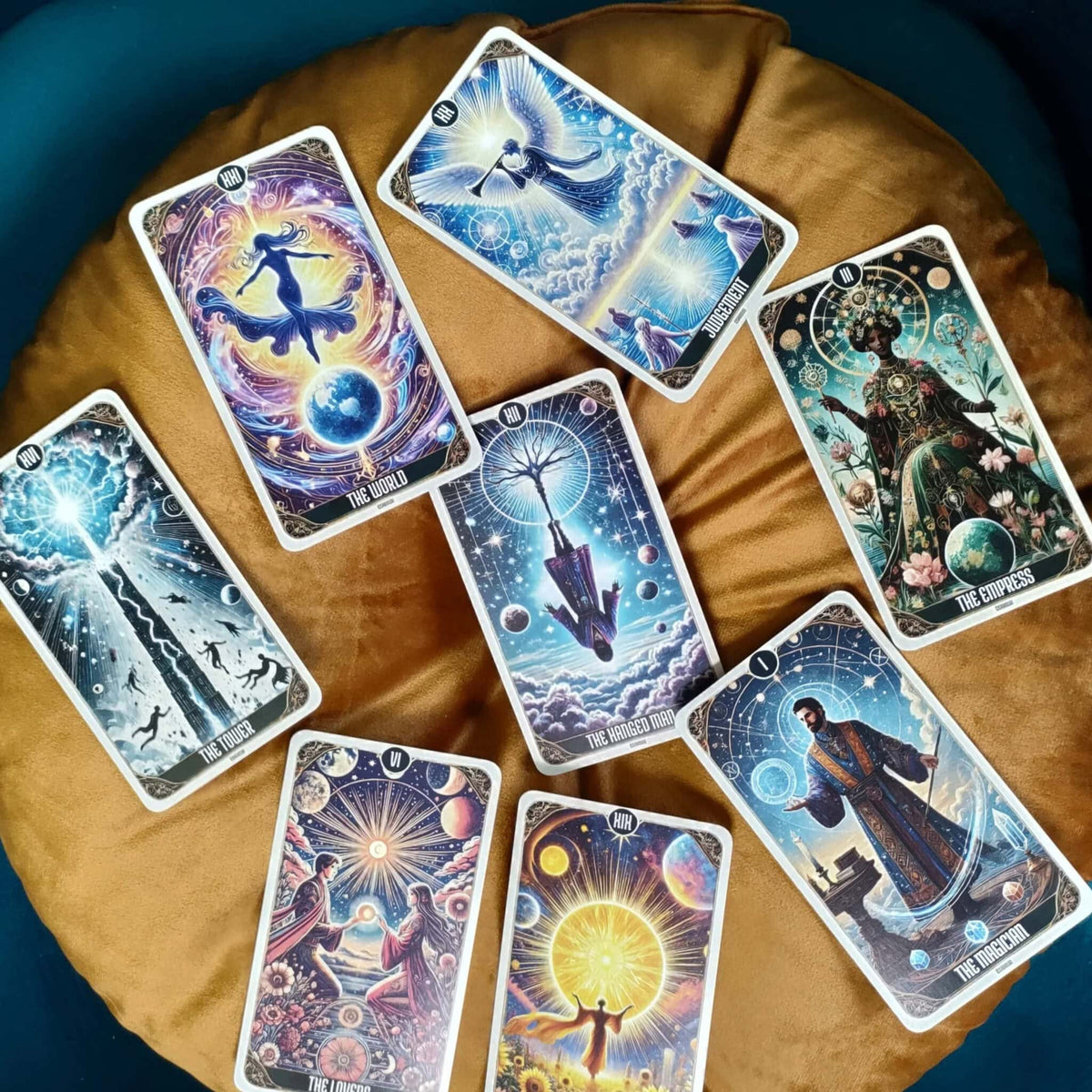
Tarot Card Meanings: The Complete Guide to All 78 Tarot Cards
VICEDOMINI contains affiliate links and is a member of the Amazon Services LLC Associates Program. If you make a purchase using one of the Amazon links, we may receive compensation at no extra cost to you. Read our disclaimer for more information.
A Tarot deck contains 78 cards, each with its own imagery, symbolism, and story.
Some speak of beginnings. Others speak of endings, choices, relationships, challenges, change, creativity, uncertainty, or growth. Together, they form a symbolic system that has been interpreted and reinterpreted for centuries.
Learning the meanings of all 78 Tarot cards can feel overwhelming at first. There are 22 Major Arcana cards, 56 Minor Arcana cards, four suits, sixteen Court Cards... and both upright and reversed meanings to explore.
You do not need to memorize everything at once. This guide is a place to return to whenever a card appears in your reading, and you want to understand it more deeply.
Below, you can explore the complete Tarot card meanings list, from The Fool to The World and from the Ace to the King of each suit. Each card includes its upright and reversed meanings, key themes, and a link to its complete interpretation.
Find the card that brought you here... or simply begin with the first one step at a time.
⮞ Table of Contents
How to Use This Tarot Card Meanings Guide
Every Tarot card could carry more than one interpretation.
Its meaning can shift depending on the question being asked, the cards surrounding it, its position within a spread, and the perspective of the person reading it.
For this reason, the meanings in this guide are best understood as starting points for interpretation.
For each of the 78 Tarot cards, you will find:
- Upright Meaning: the themes commonly associated with the card when it appears upright.
- Reversed Meaning: themes that may emerge when the card appears reversed, including internalized energy, resistance, imbalance, delay, or an alternative expression of its upright meaning.
- Key Themes: a quick way to recognize the central ideas associated with the card.
- Full Tarot Card Meaning: a deeper exploration of its imagery, symbolism, relationships, career themes, and possible interpretations when you click a single card.
You might recognize the meaning of a card immediately. At other times, its relevance may only become clearer when you consider it alongside the rest of the reading.
Tarot leaves room for both knowledge and intuition.
Major Arcana Card Meanings
The Major Arcana are the 22 cards that form the symbolic backbone of the Tarot.
Beginning with 0 — The Fool and ending with XXI — The World, they explore some of the larger experiences and archetypes we encounter throughout life: beginnings, choice, authority, relationships, change, introspection, transformation, hope, uncertainty, awakening, and completion.
Together, these cards are interpreted through a symbolic narrative known as The Fool's Journey.
The Fool begins at zero, stepping into the unknown without knowing exactly where the path will lead. Along the way, they encounter teachers, challenges, relationships, moments of uncertainty, loss, transformation, insight, and renewal before eventually arriving at The World, a symbol traditionally associated with completion and integration.
You do not have to read the Major Arcana as a literal sequence. The Fool's Journey can instead offer a framework for recognizing familiar human experiences within the cards.
When a Major Arcana card appears in a reading, it may draw attention to a larger theme, transition, lesson, or turning point surrounding the question.
And this is where we begin.
0 — The Fool

Key Themes: New beginnings · Curiosity · Freedom · Possibility · Leap of faith
Upright: New beginnings, spontaneity, openness, adventure, and stepping into the unknown.
Reversed: Hesitation, recklessness, naivety, unnecessary risk, or fear of taking the next step.
The Fool stands at the beginning of the Tarot journey.
It carries the energy of possibility, the moment before experience has told you what will happen, when the path ahead remains open.
In a reading, The Fool may appear when something new is beginning or when you are being invited to approach a situation with curiosity. Depending on the surrounding cards and question, it can also encourage you to consider the difference between trusting the unknown and moving forward without awareness.
I — The Magician

Key Themes: Manifestation · Willpower · Resourcefulness · Action · Potential
Upright: Manifestation, resourcefulness, focused intention, confidence, and using what is available to create change.
Reversed: Manipulation, scattered energy, untapped potential, self-doubt, or intention without meaningful action.
The Magician is associated with the ability to turn intention into action. Where The Fool encounters possibility, The Magician asks what you are going to do with it.
The card can draw attention to the skills, resources, knowledge, or opportunities already within reach. In other contexts, it can invite reflection on how power or influence is being used — and whether intention and action are truly aligned.
II — The High Priestess

Key Themes: Intuition · Mystery · Inner knowledge · Stillness · Subconscious
Upright: Intuition, inner knowing, mystery, reflection, and attention to what lies beneath the surface.
Reversed: Disconnection from intuition, hidden information, confusion, secrecy, or difficulty trusting your inner voice.
The High Priestess turns the attention inward. She is associated with intuition, the subconscious, and the knowledge that may emerge through observation and stillness rather than immediate action.
When she appears in a reading, there may be more to the situation than what is immediately visible. The card can invite patience, reflection, and closer attention to your instincts before reaching a conclusion.
III — The Empress

Key Themes: Abundance · Creativity · Nurturing · Nature · Growth
Upright: Abundance, creativity, nurturing energy, growth, sensuality, and connection with the natural world.
Reversed: Creative blocks, neglect, overdependence, overindulgence, or difficulty nurturing yourself or others.
The Empress represents the energy of creation and cultivation. She can speak to what grows when it is given attention, whether that is a relationship, an idea, a creative project, a sense of self-worth, or something more tangible.
When The Empress appears in a reading, she may invite you to consider what you are nurturing and whether you are allowing yourself to receive the same care you readily give elsewhere.
IV — The Emperor

Key Themes: Structure · Authority · Stability · Leadership · Boundaries
Upright: Structure, leadership, stability, responsibility, discipline, and grounded authority.
Reversed: Rigidity, excessive control, domination, instability, or difficulty establishing healthy boundaries.
The Emperor brings structure to what The Empress allows to grow. He represents boundaries, organization, responsibility, and the frameworks that create stability over time.
In a reading, The Emperor may ask where greater structure is needed — or where structure has become so rigid that it leaves little room for change. Leadership is central to this card, alongside the question of how that authority is exercised.
V — The Hierophant

Key Themes: Tradition · Teaching · Belief · Knowledge · Guidance
Upright: Tradition, spiritual or philosophical teaching, established beliefs, mentorship, and shared systems of knowledge.
Reversed: Questioning tradition, unconventional beliefs, personal interpretation, rebellion, or moving beyond inherited systems.
The Hierophant explores our relationship with knowledge, tradition, and the beliefs we inherit from those who came before us. It can represent a teacher, institution, spiritual tradition, or established way of understanding the world.
When this card appears, it may invite you to examine what your beliefs are built upon. Some traditions may offer valuable guidance; others may be ready to be questioned, reinterpreted, or understood from a different perspective.
VI — The Lovers

Key Themes: Love · Connection · Choice · Alignment · Values
Upright: Love, meaningful connection, harmony, attraction, choice, and alignment with personal values.
Reversed: Disharmony, disconnection, conflicting values, imbalance, or a difficult choice.
The Lovers naturally speaks to relationships, attraction, and meaningful connection, but its symbolism extends beyond romance. At its heart lies choice.
The card can appear when a decision asks you to consider what you genuinely value and whether your actions reflect those values. Within relationships, it may highlight connection and mutuality; elsewhere, it can point toward alignment between desire, belief, and choice.
VII — The Chariot

Key Themes: Determination · Direction · Willpower · Movement · Victory
Upright: Determination, forward movement, self-discipline, confidence, and overcoming obstacles through focused effort.
Reversed: Lack of direction, loss of control, aggression, conflicting motivations, or stalled progress.
The Chariot is movement with intention. Its imagery traditionally brings opposing forces together under the direction of a single figure, making control, determination, and focus central to its meaning.
When The Chariot appears, there may be momentum available — but direction matters. The card can ask whether your energy is moving toward something deliberately or simply moving for the sake of movement.
VIII — Strength

Key Themes: Courage · Inner Strength · Compassion · Patience · Self-Control
Upright: Courage, resilience, patience, compassion, emotional strength, and confidence from within.
Reversed: Self-doubt, insecurity, depleted confidence, vulnerability, or difficulty managing instinctive reactions.
Strength explores a quieter form of power. Rather than domination, the card traditionally depicts strength through patience, composure, courage, and the ability to meet instinct without being controlled by it.
In a reading, Strength may appear when resilience is being asked of you. It can also invite reflection on how you respond to vulnerability — your own or someone else's — and whether force is really necessary where patience might accomplish more.
IX — The Hermit

Key Themes: Introspection · Solitude · Wisdom · Reflection · Inner Guidance
Upright: Introspection, solitude, contemplation, inner guidance, and the search for deeper understanding.
Reversed: Isolation, withdrawal, loneliness, avoidance, or difficulty reconnecting with others.
The Hermit steps away from external noise in search of something that cannot easily be found there. Its lantern is traditionally associated with wisdom and illumination: enough light to see the next part of the path, rather than everything that lies ahead.
When The Hermit appears, it may suggest a period of reflection, study, or intentional solitude. It can also ask whether time alone is helping you understand yourself more clearly — or whether solitude has gradually become isolation.
X — Wheel of Fortune

Key Themes: Cycles · Change · Turning Points · Fortune · Movement
Upright: Change, cycles, opportunity, turning points, movement, and circumstances beginning to shift.
Reversed: Resistance to change, setbacks, repeating patterns, lack of control, or an unwelcome turn of events.
The Wheel of Fortune reminds us that circumstances rarely remain still. Periods begin and end. Patterns repeat. Unexpected opportunities appear. Situations once beyond movement can suddenly change direction.
In a reading, the Wheel may signal a turning point or draw your attention to a cycle already unfolding. Some parts of that cycle may be beyond your control; what remains yours is how you respond when the wheel moves again.
XI — Justice

Key Themes: Truth · Fairness · Accountability · Balance · Consequences
Upright: Truth, fairness, accountability, objectivity, ethical decisions, and consequences.
Reversed: Dishonesty, unfairness, avoidance of accountability, bias, or imbalance.
Justice asks us to look clearly at actions and their consequences. The scales represent balance and evaluation, while the sword traditionally associated with the card speaks to clarity, discernment, and the willingness to confront what is true.
When Justice appears, a situation may require honesty and careful judgment. The card can invite you to consider responsibility as well as fairness: what happened, what choices led here, and what needs to happen next?
XII — The Hanged Man

Key Themes: Surrender · Perspective · Pause · Letting Go · Reflection
Upright: Pause, surrender, release, patience, and seeing a situation from another perspective.
Reversed: Stagnation, resistance, unnecessary delay, indecision, or unwillingness to let go.
The Hanged Man changes the view by changing the position from which we look. This card often appears around pauses, periods of uncertainty, or situations that cannot be resolved through immediate action.
There can be value in waiting when waiting allows something previously unseen to become visible. The Hanged Man may therefore invite you to loosen your grip on an expected outcome and consider what becomes apparent when you stop trying to force the next step.
XIII — Death

Key Themes: Endings · Transformation · Transition · Release · Renewal
Upright: Endings, transformation, transition, release, and the beginning of a new phase.
Reversed: Resistance to change, stagnation, fear of endings, attachment to the past, or delayed transformation.
Despite its name, Death is traditionally a card of transformation rather than literal death. Something reaches its natural conclusion, creating space for what comes afterward. The process may be welcome, uncomfortable, or somewhere between the two.
When Death appears in a reading, it may draw attention to something that has run its course. The question becomes less about preserving what was and more about understanding what this ending makes possible.
XIV — Temperance

Key Themes: Balance · Moderation · Integration · Patience · Harmony
Upright: Balance, moderation, patience, integration, harmony, and finding a sustainable middle ground.
Reversed: Imbalance, excess, impatience, extremes, or difficulty bringing different parts together.
Temperance is the art of bringing different elements into relationship with one another. It speaks to adjustment, moderation, and the gradual process of finding what works... especially when extremes are pulling in opposite directions.
In a reading, Temperance may encourage patience and thoughtful integration. The answer may emerge through refinement rather than dramatic action: a little more here, a little less there, until something begins to feel sustainable.
XV — The Devil

Key Themes: Attachment · Temptation · Restriction · Desire · Shadow
Upright: Attachment, temptation, unhealthy patterns, material fixation, restriction, or feeling bound to something.
Reversed: Liberation, awareness, breaking patterns, reclaiming agency, or beginning to release an unhealthy attachment.
The Devil explores the things that can hold power over us. These might be desires, habits, relationships, fears, beliefs, or patterns that feel difficult to escape. Sometimes the restriction is external; sometimes we participate in maintaining it ourselves.
When The Devil appears, it can invite uncomfortable but useful honesty. What has more influence over you than you would like to admit? And once you recognize the pattern, how much of that power can you begin to reclaim?
XVI — The Tower

Key Themes: Upheaval · Revelation · Disruption · Collapse · Truth
Upright: Sudden change, disruption, revelation, instability, and the collapse of an existing structure.
Reversed: Resistance to inevitable change, avoiding disruption, internal upheaval, or delaying a necessary reckoning.
The Tower represents the moment when something can no longer remain as it was. A belief may be challenged. A structure may fail. Information may emerge that changes how a situation is understood.
The experience can be disruptive precisely because it removes certainty. Yet what collapses may also reveal weaknesses that were already present. When The Tower appears, the question may be what remains once the illusion of stability has fallen away.
XVII — The Star

Key Themes: Hope · Renewal · Inspiration · Healing · Possibility
Upright: Hope, renewal, inspiration, healing, openness, and renewed faith in what may be possible.
Reversed: Discouragement, disconnection, loss of hope, self-doubt, or difficulty seeing a way forward.
After the disruption of The Tower comes The Star. Its energy is quieter: a return to possibility, openness, and the sense that something can begin again even after uncertainty or loss.
When The Star appears, it may point toward healing or renewed confidence in the future. It does not necessarily promise that every difficulty has disappeared; instead, it can mark the moment when you begin to see beyond it.
XVIII — The Moon

Key Themes: Intuition · Uncertainty · Illusion · Subconscious · Mystery
Upright: Intuition, uncertainty, dreams, subconscious influences, ambiguity, and what remains unseen.
Reversed: Emerging clarity, confronting fear, revealed information, confusion beginning to lift, or deeper self-deception.
The Moon illuminates without revealing everything. Under its light, familiar shapes can look different, making this a card closely associated with intuition, uncertainty, dreams, fear, and perception.
When The Moon appears, all the information you need may not yet be available. Rather than rushing toward certainty, it can encourage you to notice what you feel, what you assume, and what you actually know.
XIX — The Sun

Key Themes: Joy · Vitality · Clarity · Confidence · Success
Upright: Joy, optimism, vitality, clarity, confidence, warmth, and success.
Reversed: Temporary setbacks, diminished enthusiasm, unrealistic optimism, delayed success, or difficulty recognizing what is going well.
The Sun brings things into the light. It is traditionally one of Tarot's most positive cards, associated with vitality, clarity, confidence, and the freedom that comes when something can be seen without ambiguity.
In a reading, The Sun may highlight a period of openness, achievement, or renewed energy. It can also be wonderfully simple: sometimes there is something good here, and you are allowed to recognize it.
XX — Judgement

Key Themes: Awakening · Reflection · Calling · Reckoning · Renewal
Upright: Self-reflection, awakening, accountability, renewal, decisive realization, and responding to an inner calling.
Reversed: Self-doubt, avoidance, harsh self-judgment, refusal to learn from experience, or difficulty answering a call to change.
Judgement represents a moment of recognition. Something previously experienced can now be understood differently. Past choices, patterns, or experiences may return to awareness — this time with the possibility of responding from a new perspective.
When Judgement appears, it may ask you to look back without becoming trapped there. What have you learned? What are you ready to acknowledge? And what becomes possible when that understanding informs the decision you make now?
XXI — The World

Key Themes: Completion · Integration · Fulfilment · Wholeness · Achievement
Upright: Completion, fulfillment, integration, accomplishment, closure, and reaching the end of a meaningful cycle.
Reversed: Incompletion, lack of closure, unfinished business, delays, or being close to completion without quite arriving.
The World completes the Major Arcana. What began with The Fool stepping into the unknown arrives here with experience, perspective, and integration.
The World can appear when a significant cycle reaches completion or when the different pieces of an experience finally begin to make sense together. There may be achievement to acknowledge, closure to accept, or simply a moment to recognize how far you have traveled before beginning again.
Because after The World, the deck returns to The Fool, and another journey begins.
Minor Arcana Tarot Card Meanings
While the Major Arcana explore larger archetypal themes and turning points, the 56 Minor Arcana cards bring Tarot into the experiences of everyday life.
They speak to how we feel, think, communicate, work, create, relate to others, make decisions, manage resources, pursue ambitions, and respond to challenges.
The Minor Arcana are divided into four suits:
- Cups: Water = Emotions, relationships & intuition
- Pentacles: Earth = Resources, work & material life
- Swords: Air = Thought, communication & conflict
- Wands: Fire = Creativity, action & ambition
Each suit contains 14 cards: Ace through Ten, followed by four Court Cards: Page, Knight, Queen, and King.
The numbered cards often explore how the energy of a suit develops through different situations and stages, while the Court Cards can represent people, qualities, approaches, roles, or ways of expressing that suit's energy.
Together, the Minor Arcana bring the symbolic language of Tarot closer to the questions we encounter every day.
Suit of Cups Tarot Card Meanings
Element: Water
Themes: Emotions · Relationships · Intuition · Connection
The Suit of Cups explores our emotional world... love, relationships, vulnerability, intuition, connection, creativity, grief, fulfillment, and emotional change can all emerge through these fourteen cards.
Because Cups are traditionally associated with the element of Water, their symbolism is fluid. Feelings move, relationships change, and what lies beneath the surface can influence how we experience what is happening around us.
When Cups dominate a Tarot reading, the emotional dimension of the question may deserve particular attention.
Ace of Cups

Key Themes: Emotional Beginnings · Love · Openness · Compassion · Intuition
Upright: New emotional beginnings, love, compassion, openness, creativity, and emotional potential.
Reversed: Blocked emotions, emotional overwhelm, repression, difficulty receiving love, or the need to direct care inward.
The Ace of Cups represents emotional potential in its earliest form. It might appear with the beginning of a relationship, a renewed sense of connection, creative inspiration, or an opening of the heart toward something meaningful.
As with every Ace, the opportunity is present rather than guaranteed. What happens next depends on how that emotional energy is received, expressed, and allowed to develop.
Two of Cups

Key Themes: Partnership · Connection · Mutuality · Attraction · Harmony
Upright: Partnership, mutual attraction, emotional connection, cooperation, and reciprocal understanding.
Reversed: Disconnection, imbalance, tension, miscommunication, or unequal emotional exchange.
The Two of Cups brings two energies into relationship. It is often associated with romantic connection, but its meaning can extend to friendship, partnership, reconciliation, or any relationship built upon mutual recognition.
The emphasis is on reciprocity: two sides meeting one another. In a reading, it may therefore invite you to consider not only what you feel, but what is being exchanged between you.
Three of Cups

Key Themes: Friendship · Celebration · Community · Support · Joy
Upright: Celebration, friendship, community, collaboration, shared happiness, and emotional support.
Reversed: Social tension, overindulgence, isolation, gossip, or feeling disconnected from a group.
The Three of Cups celebrates connection beyond the individual. It can represent friendship, community, shared achievement, or simply the joy of being surrounded by people with whom something meaningful can be shared.
When it appears, the card may invite you to recognize the relationships that support you — or consider whether your current social environment genuinely offers that sense of belonging.
Four of Cups

Key Themes: Contemplation · Apathy · Withdrawal · Reassessment · Opportunity
Upright: Contemplation, emotional withdrawal, apathy, dissatisfaction, or overlooking an available opportunity.
Reversed: Renewed interest, emotional awareness, acceptance, re-engagement, or recognizing previously overlooked possibilities.
The Four of Cups turns attention inward. Something may be available, yet difficult to appreciate because attention is fixed elsewhere. The card can appear during periods of dissatisfaction, emotional fatigue, or contemplation.
Its invitation is subtle: before deciding that nothing meaningful is being offered, look again.
Five of Cups

Key Themes: Loss · Grief · Disappointment · Perspective · Healing
Upright: Loss, disappointment, grief, regret, and attention focused on what has gone wrong.
Reversed: Acceptance, healing, forgiveness, moving forward, and gradually recognizing what remains.
The Five of Cups acknowledges disappointment without pretending it does not hurt. Something may have been lost, changed, or failed to become what you hoped.
Yet the symbolism of this card also contains what remains. Healing does not require ignoring loss; it may begin when grief and possibility are allowed to exist alongside one another.
Six of Cups

Key Themes: Nostalgia · Memory · Innocence · Familiarity · Generosity
Upright: Nostalgia, childhood memories, kindness, familiarity, innocence, and reconnecting with the past.
Reversed: Being trapped in the past, unrealistic nostalgia, outgrowing old patterns, or becoming more independent.
The Six of Cups looks backward. Memories, familiar people, places, or feelings may return, carrying comfort as well as perspective on how much has changed.
When this card appears, nostalgia can be meaningful — but memory is selective. The Six of Cups may invite you to appreciate what the past gave you while remaining aware of the life you are living now.
Seven of Cups

Key Themes: Choices · Imagination · Possibility · Illusion · Discernment
Upright: Multiple possibilities, imagination, fantasy, choices, wishful thinking, and difficulty knowing what is real.
Reversed: Clarity, narrowing your options, making a decision, or recognizing an illusion for what it is.
The Seven of Cups presents many possibilities at once. Some may be genuine opportunities. Others may look appealing precisely because they have not yet been tested against reality.
This card asks for discernment. Imagination can reveal possibilities, but eventually a choice must move from fantasy into something tangible.
Eight of Cups

Key Themes: Departure · Release · Search · Transition · Emotional Growth
Upright: Walking away, leaving something behind, emotional transition, seeking deeper meaning, and recognizing when something is no longer fulfilling.
Reversed: Fear of leaving, avoidance, returning to an old situation, indecision, or remaining where fulfillment has already faded.
The Eight of Cups is the decision to leave something that no longer feels sufficient. That decision does not necessarily mean the experience had no value. Sometimes we leave precisely because we have learned what it had to teach us.
When this card appears, it may ask what you are still holding onto and whether staying brings you closer to what you actually seek.
Nine of Cups

Key Themes: Satisfaction · Pleasure · Gratitude · Wishes · Fulfilment
Upright: Satisfaction, pleasure, gratitude, emotional fulfillment, confidence, and enjoying what has been achieved.
Reversed: Dissatisfaction, excess, superficial fulfillment, unrealistic expectations, or discovering that getting what you wanted did not feel as expected.
The Nine of Cups is traditionally associated with wishes and emotional satisfaction.
It can represent the pleasure of recognizing that something you hoped for has arrived.
Yet fulfillment also invites reflection. What genuinely satisfies you? And are you enjoying what you have, or already searching for the next thing that might finally feel like enough?
Ten of Cups

Key Themes: Harmony · Belonging · Family · Connection · Emotional Fulfilment
Upright: Emotional fulfillment, harmony, belonging, lasting connection, shared happiness, and supportive relationships.
Reversed: Relationship tension, disconnection, unrealistic expectations, family conflict, or a gap between outward appearance and emotional reality.
The Ten of Cups expands emotional fulfillment beyond the individual. It can speak to family, chosen family, partnership, community, or the experience of belonging somewhere where connection feels mutual.
When this card appears, it may highlight what emotional abundance looks like when it is shared, and what makes a relationship or community feel like home.
Page of Cups

Key Themes: Curiosity · Intuition · Creativity · Sensitivity · Messages
Upright: Emotional curiosity, creativity, intuitive messages, openness, sensitivity, and unexpected inspiration.
Reversed: Emotional immaturity, creative blocks, insecurity, ignored intuition, or difficulty expressing feelings.
The Page of Cups approaches emotion with curiosity. As a Court Card, the Page may represent a person, a message, or a way of engaging with experience: open, imaginative, sensitive, and willing to be surprised.
When this card appears, something may be asking you to listen without immediately deciding what it means. A feeling, idea, or intuitive impression could be worth exploring before dismissing it.
Knight of Cups

Key Themes: Romance · Idealism · Invitation · Creativity · Following the Heart
Upright: Romance, charm, creativity, emotional pursuit, heartfelt invitations, and following what feels meaningful.
Reversed: Unrealistic expectations, moodiness, emotional inconsistency, empty promises, or idealizing a situation.
The Knight of Cups follows what moves the heart. This could be romantic, creative, artistic, or deeply personal. The Knight brings movement to the emotional world of Cups, turning feeling into pursuit.
Its challenge lies in idealization. Inspiration can lead somewhere beautiful, but the Knight may also ask whether the reality of what you are pursuing can support the dream you have created around it.
Queen of Cups

Key Themes: Compassion · Intuition · Empathy · Emotional Depth · Care
Upright: Compassion, intuition, emotional maturity, empathy, sensitivity, and deep understanding.
Reversed: Emotional overwhelm, insecurity, poor boundaries, self-neglect, or becoming consumed by the emotions of others.
The Queen of Cups understands emotion without needing to escape it. She represents empathy, intuitive awareness, and the ability to hold emotional complexity with care.
In a reading, she may encourage compassion while also raising an important question about boundaries. Sensitivity can be a strength, but caring deeply for others does not require abandoning yourself.
King of Cups

Key Themes: Emotional Maturity · Balance · Wisdom · Diplomacy · Compassion
Upright: Emotional maturity, calm leadership, diplomacy, compassion, wisdom, and balanced emotional expression.
Reversed: Emotional manipulation, repression, volatility, detachment, or difficulty managing feelings constructively.
The King of Cups represents emotional depth held with stability. Feelings are present, sometimes intensely, but they do not have to dictate every response.
When the King appears, he may invite emotional maturity: recognizing what you feel, understanding its significance, and choosing how to respond rather than simply reacting.
Suit of Pentacles Tarot Card Meanings
Element: Earth
Themes: Resources · Work · Stability · Material Life · Growth
The Suit of Pentacles explores the tangible side of life, work, money, resources, security, health, home, skills, long-term goals, and the way we build stability can all appear through these fourteen cards.
Pentacles are traditionally associated with the element of Earth, connecting the suit with what can be developed, maintained, experienced, and brought into physical form.
Yet material abundance is only part of their story.
The Pentacles also ask how we use what we have: where we invest our time, what we value, what we are building, and whether the foundations beneath it can support us over time.
When Pentacles appear frequently in a Tarot reading, practical circumstances may deserve particular attention.
Ace of Pentacles

Key Themes: Opportunity · Prosperity · Potential · Stability · New Beginnings
Upright: New opportunities, material potential, prosperity, stability, manifestation, and the beginning of something tangible.
Reversed: Missed opportunities, poor planning, financial instability, delays, or potential that has not yet been developed.
The Ace of Pentacles represents the beginning of something that has the potential to become real and lasting. It might appear around work, money, study, health, home, or any opportunity requiring practical action and consistent attention.
Like every Ace, it represents potential rather than a finished result. The seed is there. What grows from it depends on what you choose to build.
Two of Pentacles

Key Themes: Balance · Adaptability · Priorities · Flexibility · Change
Upright: Balance, adaptability, managing priorities, flexibility, and responding to changing circumstances.
Reversed: Overcommitment, imbalance, disorganization, poor prioritization, or struggling to manage competing demands.
The Two of Pentacles is about keeping several things in motion. Responsibilities, resources, work, relationships, or practical demands may all be asking for attention at the same time.
When this card appears, flexibility can be more useful than perfect control. It may also ask a simple question: what genuinely needs your attention now, and what can wait?
Three of Pentacles

Key Themes: Collaboration · Skill · Teamwork · Learning · Craftsmanship
Upright: Collaboration, teamwork, developing skills, learning from others, and contributing your abilities toward a shared goal.
Reversed: Poor teamwork, lack of cooperation, uneven effort, weak planning, or work that needs further development.
The Three of Pentacles shows what can happen when individual ability becomes part of something larger. It speaks to learning, collaboration, craftsmanship, and recognizing that meaningful work often develops through practice and exchange.
In a reading, the card may encourage you to consider the people around you. Who has something to teach you? Where could collaboration strengthen what you are trying to build?
Four of Pentacles

Key Themes: Security · Control · Possession · Stability · Protection
Upright: Security, stability, saving, protecting resources, maintaining control, and holding tightly to what you value.
Reversed: Possessiveness, greed, fear of loss, overspending, releasing control, or reconsidering your relationship with security.
The Four of Pentacles explores the boundary between security and attachment. Protecting what you have can be sensible. Yet when protection becomes fear, the desire for stability can begin to restrict movement and growth.
When this card appears, it may ask what you are holding onto and whether holding it so tightly is genuinely making you feel safer.
Five of Pentacles

Key Themes: Hardship · Scarcity · Exclusion · Struggle · Support
Upright: Financial or material hardship, insecurity, isolation, scarcity, and feeling unsupported.
Reversed: Recovery, improvement, accepting support, rebuilding stability, or gradually moving beyond difficulty.
The Five of Pentacles acknowledges periods when resources, security, or support feel limited. Its themes can be financial, practical, physical, or emotional, particularly when hardship creates a sense of being alone in the experience.
Yet this card can also raise the question of available support. Difficulty may be real without meaning that it must be faced entirely alone.
Six of Pentacles

Key Themes: Giving · Receiving · Generosity · Support · Exchange
Upright: Generosity, assistance, sharing resources, reciprocity, and balance between giving and receiving.
Reversed: Unequal exchange, strings attached, exploitation, one-sided generosity, debt, or imbalance in giving and receiving.
The Six of Pentacles explores the movement of resources between people. Sometimes you are in the position to give. Sometimes you need to receive. Neither position is permanent.
When this card appears, it may ask you to look at the balance within an exchange. Is support being offered freely? Is receiving difficult for you? And is what is being shared creating greater balance or reinforcing an imbalance?
Seven of Pentacles

Key Themes: Patience · Investment · Progress · Evaluation · Long-Term Growth
Upright: Patience, long-term planning, assessment, investment, perseverance, and waiting for results to develop.
Reversed: Impatience, limited progress, poor investment, frustration, or questioning whether continued effort is worthwhile.
The Seven of Pentacles pauses to examine what has been growing. Effort has already been invested, but the final result has not yet arrived.
This card may appear when patience is necessary, but it does not ask for patience without thought. Can it also invite evaluation: is this worth continuing to cultivate, or would your time and resources be better invested elsewhere?
Eight of Pentacles

Key Themes: Skill · Practice · Dedication · Mastery · Craftsmanship
Upright: Practice, diligence, craftsmanship, focus, learning, and developing mastery through repeated effort.
Reversed: Lack of focus, poor-quality work, perfectionism, repetition without progress, or insufficient commitment.
The Eight of Pentacles is the card of practice. Skill rarely appears fully formed. It develops through repetition, attention, mistakes, adjustment, and the willingness to keep learning.
When this card appears, progress may depend less on inspiration and more on consistency. It asks what could become possible if you continued refining what you already know.
Nine of Pentacles

Key Themes: Independence · Abundance · Self-Sufficiency · Achievement · Reward
Upright: Independence, self-sufficiency, abundance, earned success, comfort, and enjoying the results of your work.
Reversed: Financial dependence, instability, overinvestment in appearances, setbacks, or difficulty recognizing your own value.
The Nine of Pentacles represents what has been cultivated through sustained effort. There is independence here, alongside the ability to enjoy what has been created rather than constantly chasing the next achievement.
When this card appears, it may invite you to recognize what you have built for yourself — materially, professionally, or personally — and the work that made it possible.
Ten of Pentacles

Key Themes: Legacy · Stability · Family · Wealth · Long-Term Security
Upright: Long-term stability, legacy, family resources, financial security, tradition, and lasting achievement.
Reversed: Financial instability, family conflict, unstable foundations, short-term thinking, or challenges surrounding inheritance and shared resources.
The Ten of Pentacles looks beyond immediate success toward what lasts. It can represent family, home, accumulated resources, shared security, tradition, or something built with the potential to continue beyond the present moment.
In a reading, the card may ask what kind of stability you are creating, and what you hope will remain after the immediate goal has been reached.
Page of Pentacles

Key Themes: Learning · Opportunity · Ambition · Practicality · Potential
Upright: New opportunities, study, ambition, practical learning, curiosity, and the desire to turn an idea into something tangible.
Reversed: Lack of focus, procrastination, missed opportunities, poor planning, or difficulty translating ideas into action.
The Page of Pentacles approaches the material world as a student. There might be something new to learn, develop, practice, or begin building.
When this card appears, curiosity becomes most valuable when paired with action. An idea may have potential, but the Page asks whether you are willing to learn what is required to make it real.
Knight of Pentacles

Key Themes: Reliability · Discipline · Patience · Responsibility · Progress
Upright: Hard work, reliability, responsibility, patience, routine, and steady progress toward a long-term goal.
Reversed: Stagnation, stubbornness, boredom, perfectionism, lack of progress, or becoming trapped in routine.
The Knight of Pentacles moves slowly, but deliberately. Unlike the more impulsive Knights, this one values consistency, responsibility, and finishing what has been started.
When the Knight appears, dramatic movement may not be necessary. Progress can come from doing the ordinary things well, repeatedly, until they accumulate into something substantial.
Queen of Pentacles

Key Themes: Practicality · Nurturing · Security · Resourcefulness · Abundance
Upright: Practicality, nurturing, resourcefulness, financial awareness, stability, and creating a supportive environment.
Reversed: Self-neglect, imbalance between work and personal life, financial insecurity, overextension, or difficulty caring for your own needs.
The Queen of Pentacles brings care into the practical world. Her nurturing is expressed through what can be sustained: creating security, managing resources thoughtfully, tending to everyday needs, and making an environment feel supported.
When she appears, she may ask whether you are creating stability for yourself as carefully as you create it for everyone else.
King of Pentacles

Key Themes: Stability · Leadership · Abundance · Mastery · Responsibility
Upright: Material stability, responsible leadership, financial maturity, success, discipline, and long-term achievement.
Reversed: Greed, materialism, poor financial judgment, controlling behavior, or prioritizing status over substance.
The King of Pentacles represents mastery of the material realm. Resources have been accumulated, experience has been gained, and the question becomes how both are managed.
In a reading, the King may represent dependable leadership, financial maturity, or long-term success. He can also invite reflection on the difference between possessing resources and using them wisely.
Suit of Swords Tarot Card Meanings
Element: Air
Themes: Thought · Communication · Truth · Decisions · Conflict
The Suit of Swords explores the world of the mind: thoughts, beliefs, communication, decisions, truth, conflict, perception, and the stories we tell ourselves.
Swords are traditionally associated with the element of Air, connecting them with intellect, language, reason, and perspective.
A sword can cut through confusion, but it can also wound. That duality runs throughout the suit. Clear thinking can bring understanding; overthinking can create paralysis. Words can reveal truth or deepen conflict. Decisions can free us or carry difficult consequences.
When Swords appear frequently in a Tarot reading, pay attention to what is happening in the mind — and to the difference between what you know, what you fear, and what you assume.
Ace of Swords

Key Themes: Clarity · Truth · Breakthrough · Ideas · Insight
Upright: Mental clarity, truth, new ideas, breakthroughs, communication, and seeing a situation more clearly.
Reversed: Confusion, misinformation, poor communication, clouded judgment, or difficulty reaching clarity.
The Ace of Swords is the beginning of understanding. An idea emerges. A truth becomes visible. Something previously confusing may suddenly be easier to name.
Yet clarity carries responsibility. Once something has been recognized, the question becomes what you choose to do with that understanding.
Two of Swords

Key Themes: Indecision · Choice · Stalemate · Avoidance · Reflection
Upright: Indecision, difficult choices, uncertainty, avoidance, and needing more information before moving forward.
Reversed: Information overload, prolonged indecision, confusion, delayed choice, or finally confronting what has been avoided.
The Two of Swords sits between possibilities. A decision may be necessary, yet neither option feels entirely clear.
Sometimes waiting allows more information to emerge. At other times, refusing to choose becomes a choice of its own. This card asks what is genuinely unclear, and what you may already know but feel reluctant to confront.
Three of Swords

Key Themes: Heartbreak · Sorrow · Truth · Separation · Healing
Upright: Heartbreak, grief, disappointment, painful truth, separation, and emotional pain.
Reversed: Healing, forgiveness, recovery, processing grief, or pain that has not yet been fully addressed.
The Three of Swords does not soften difficult emotions. Something hurts, disappoints, or reveals a truth that may be painful to accept.
Yet naming pain can be part of understanding it. When this card appears, healing may begin through allowing yourself to acknowledge what happened rather than trying to move past it before you are ready.
Four of Swords

Key Themes: Rest · Recovery · Pause · Reflection · Restoration
Upright: Rest, recovery, contemplation, stillness, and stepping away to regain perspective.
Reversed: Restlessness, burnout, exhaustion, returning before you are ready, or recognizing an urgent need for rest.
The Four of Swords creates a pause. After tension or difficulty, the mind needs space to recover.
This card may appear when continued effort is no longer productive. Rest can be part of progress too — especially when clarity has become difficult to find through constant movement.
Five of Swords

Key Themes: Conflict · Tension · Ego · Victory · Consequences
Upright: Conflict, tension, disagreement, hostility, competition, and winning at a cost.
Reversed: Reconciliation, resolution, lingering resentment, making amends, or choosing to step away from conflict.
The Five of Swords asks what victory is worth. A disagreement may technically have a winner, yet leave everyone involved carrying the consequences.
When this card appears, it can draw attention to conflict, ego, communication, and the aftermath of difficult interactions. Being right and creating resolution are not always the same thing.
Six of Swords

Key Themes: Transition · Moving Forward · Recovery · Change · Passage
Upright: Transition, moving forward, leaving difficulty behind, recovery, and gradual movement toward calmer circumstances.
Reversed: Resistance to change, unresolved issues, emotional baggage, difficulty moving on, or returning to something unfinished.
The Six of Swords represents movement away from turbulence. The destination may not yet be fully visible, and the past may still be traveling with you.
This is often a gradual transition rather than a dramatic escape. Sometimes moving forward begins before you feel completely ready to leave what came before.
Seven of Swords

Key Themes: Strategy · Secrecy · Independence · Deception · Tactics
Upright: Strategy, discretion, acting independently, secrecy, avoidance, or deception.
Reversed: Confession, exposure, reconsidering your approach, self-deception, or taking responsibility for hidden actions.
The Seven of Swords is a card of strategy and sometimes secrecy. There are situations where discretion is wise, and others where secrecy becomes avoidance or dishonesty.
When this card appears, motivation matters. What is happening out of view? And is the chosen strategy genuinely intelligent, or simply postponing a truth that will eventually need to be faced?
Eight of Swords

Key Themes: Restriction · Fear · Perspective · Limitation · Powerlessness
Upright: Feeling trapped, self-imposed limitations, fear, restricted perspective, and believing there are fewer options than actually exist.
Reversed: New perspective, reclaiming agency, self-acceptance, freedom, or beginning to recognize available choices.
The Eight of Swords explores the experience of feeling trapped. The restrictions may be real, perceived, or a combination of both. Fear can narrow perspective until possibilities become difficult to recognize.
When this card appears, it may be useful to distinguish between what truly cannot be changed and what has simply begun to feel impossible.
Nine of Swords

Key Themes: Anxiety · Worry · Fear · Overthinking · Distress
Upright: Anxiety, worry, overthinking, sleeplessness, fear, and mental distress.
Reversed: Beginning to release anxiety, seeking support, confronting fears, or becoming increasingly overwhelmed by them.
The Nine of Swords depicts the mind at its most relentless. Thoughts repeat. Fears grow in the absence of certainty. What feels manageable during the day may become enormous in the quiet of the night.
When this card appears, it may highlight the difference between a feared outcome and an established reality while also acknowledging that the distress itself can still feel very real.
Ten of Swords

Key Themes: Ending · Collapse · Finality · Acceptance · Transition
Upright: Painful endings, defeat, finality, collapse, and recognizing that something has reached its conclusion.
Reversed: Recovery, survival, resisting an inevitable ending, lingering pain, or beginning to rise after difficulty.
The Ten of Swords marks an ending that is difficult to ignore. Something has reached its limit.
Yet finality also creates a boundary between what has happened and what can happen next. The card may appear at a painful conclusion, while quietly containing the recognition that this particular chapter cannot continue forever.
Page of Swords

Key Themes: Curiosity · Communication · Ideas · Observation · Learning
Upright: Curiosity, mental energy, new ideas, communication, questioning, and eagerness to learn.
Reversed: Gossip, poor communication, scattered thinking, empty talk, defensiveness, or speaking before understanding.
The Page of Swords wants to know more. Questions, ideas, information, and conversation can arrive quickly when this card appears.
Curiosity is its strength. Discernment is its lesson. Not every piece of information deserves immediate belief or immediate repetition.
Knight of Swords

Key Themes: Action · Ambition · Directness · Speed · Conviction
Upright: Swift action, determination, ambition, direct communication, conviction, and pursuing an idea decisively.
Reversed: Recklessness, aggression, impulsive decisions, poor direction, or acting without considering consequences.
The Knight of Swords moves quickly once the destination is clear. Conviction can create extraordinary momentum, especially when a decision has already been made.
Yet speed leaves less time for reflection. When this Knight appears, the question may not be whether you can move forward quickly, but whether you understand what your momentum might leave behind.
Queen of Swords

Key Themes: Discernment · Independence · Honesty · Perception · Boundaries
Upright: Clear thinking, independence, honesty, discernment, direct communication, and strong boundaries.
Reversed: Bitterness, harsh judgment, cold communication, cynicism, or allowing past hurt to shape present perception.
The Queen of Swords sees clearly and speaks accordingly. Experience has sharpened her discernment, making boundaries, honesty, and intellectual independence central to this card.
When she appears, emotion does not need to disappear for clarity to exist. Instead, the invitation may be to understand what you feel without allowing it to obscure what you can see.
King of Swords

Key Themes: Truth · Authority · Logic · Integrity · Intellectual Mastery
Upright: Clear judgment, intellectual authority, truth, discipline, objectivity, and principled decision-making.
Reversed: Manipulation, misuse of authority, rigidity, dishonesty, cruelty, or intellectual arrogance.
The King of Swords represents the mature expression of the suit's intellectual energy. Knowledge alone is not enough; judgment matters too.
In a reading, this King may call for objectivity, careful reasoning, and decisions grounded in principle rather than convenience. Authority becomes most valuable when it is accompanied by integrity.
Suit of Wands Tarot Card Meanings
Element: Fire
Themes: Creativity · Action · Passion · Ambition · Energy
The Suit of Wands explores the energy that moves us forward; creativity, ambition, inspiration, confidence, desire, momentum, personal growth, and the courage to act can all emerge through these fourteen cards.
Wands are traditionally associated with the element of Fire, connecting the suit with movement, transformation, passion, and creative force.
Fire can illuminate, warm, and inspire. It can also burn too quickly when there is nothing sustaining it.
That tension runs throughout the Suit of Wands. Inspiration needs direction. Ambition needs endurance. Action needs purpose.
When Wands appear frequently in a Tarot reading, pay attention to where your energy is going — what excites you, what motivates you, and what you are ready to pursue.
Ace of Wands

Key Themes: Inspiration · Potential · Creativity · Energy · New Beginnings
Upright: Inspiration, creative potential, enthusiasm, new beginnings, opportunity, and the desire to take action.
Reversed: Creative blocks, lack of direction, delayed beginnings, low motivation, or an idea that has not yet found its form.
The Ace of Wands is the spark. An idea, desire, opportunity, or burst of inspiration appears, carrying the potential for something new.
Like every Ace, it represents a beginning rather than a completed outcome. The energy is available. The question is what you choose to do with it.
Two of Wands

Key Themes: Planning · Possibility · Direction · Decisions · Future
Upright: Planning, future possibilities, personal direction, decision-making, and considering what comes next.
Reversed: Fear of change, limited planning, hesitation, uncertainty, or remaining within familiar boundaries.
The Two of Wands looks beyond what is already known. The initial spark of the Ace has created possibility, and now a decision begins to form around where that possibility might lead.
When this card appears, you may be standing between familiarity and expansion. Before moving forward, it asks you to consider where you actually want to go.
Three of Wands

Key Themes: Expansion · Progress · Foresight · Opportunity · Growth
Upright: Expansion, progress, foresight, exploration, opportunity, and seeing early efforts begin to develop.
Reversed: Delays, obstacles, limited progress, lack of foresight, or expectations that need adjustment.
The Three of Wands looks toward a wider horizon. Plans have begun moving beyond the idea stage, and attention turns toward what might develop from them.
When this card appears, it may signal expansion or encourage you to think beyond your immediate surroundings. Progress has begun, but the path may extend further than you originally imagined.
Four of Wands

Key Themes: Celebration · Stability · Home · Community · Milestone
Upright: Celebration, harmony, community, homecoming, stability, and reaching a meaningful milestone.
Reversed: Instability, tension at home, lack of support, disrupted celebrations, or difficulty feeling a sense of belonging.
The Four of Wands creates a moment to recognize what has been achieved. It can represent celebration, home, community, relationships, or the stability that allows people to come together.
When this card appears, there may be something worth acknowledging before rushing toward the next goal. Progress deserves moments of recognition too.
Five of Wands

Key Themes: Competition · Conflict · Tension · Challenge · Differing Perspectives
Upright: Competition, disagreement, conflicting priorities, tension, challenges, and energetic friction.
Reversed: Conflict avoidance, resolution, compromise, internal tension, or competition beginning to ease.
The Five of Wands brings different energies into collision. Everyone may be moving, speaking, or striving at once, creating friction without necessarily creating progress.
Not every disagreement is destructive. Some forms of tension expose different perspectives or encourage growth. The question is whether the conflict is producing something useful or simply consuming energy.
Six of Wands

Key Themes: Victory · Recognition · Confidence · Achievement · Success
Upright: Success, recognition, achievement, confidence, public acknowledgment, and progress after effort.
Reversed: Lack of recognition, self-doubt, disappointment, private achievement, or depending too heavily on external validation.
The Six of Wands represents recognition after effort. Something has gone well, progress has become visible, or other people may finally acknowledge what has been accomplished.
Yet recognition raises another question: how much does your sense of success depend on being witnessed?
When this card appears, celebrate what has been achieved while remembering that external applause is only one measure of progress.
Seven of Wands

Key Themes: Perseverance · Defence · Boundaries · Courage · Conviction
Upright: Standing your ground, perseverance, defending your position, courage, boundaries, and maintaining conviction under pressure.
Reversed: Exhaustion, overwhelm, giving up, defensiveness, or questioning whether something is still worth fighting for.
The Seven of Wands asks what you are willing to defend. Progress can attract challenge, disagreement, or pressure from outside.
This card may encourage you to maintain your position when it matters. It can also invite discernment: not every battle deserves the same amount of your energy.
Eight of Wands

Key Themes: Movement · Momentum · Communication · Speed · Progress
Upright: Rapid movement, momentum, communication, progress, incoming information, and events developing quickly.
Reversed: Delays, miscommunication, frustration, scattered energy, or momentum being interrupted.
The Eight of Wands accelerates. What once felt slow may suddenly begin moving, bringing messages, decisions, opportunities, or developments in quick succession.
When this card appears, there may be little need to force momentum because momentum is already present. The challenge becomes staying focused while everything around you begins to move.
Nine of Wands

Key Themes: Resilience · Persistence · Boundaries · Endurance · Vigilance
Upright: Resilience, persistence, endurance, caution, boundaries, and continuing despite previous difficulties.
Reversed: Exhaustion, defensiveness, burnout, giving up, or struggling to maintain the energy to continue.
The Nine of Wands carries the experience of everything that came before it. You might be tired, you might have reasons to be cautious, and yet something has kept you standing.
When this card appears, resilience is important, but so is recognizing its cost. Continuing can require courage; knowing when you need recovery can require just as much.
Ten of Wands

Key Themes: Responsibility · Burden · Pressure · Workload · Completion
Upright: Responsibility, heavy workload, burden, pressure, commitment, and carrying something toward completion.
Reversed: Release, delegation, burnout, reducing responsibilities, or avoiding a responsibility that still needs attention.
The Ten of Wands carries a heavy load. A goal may be close to completion, but the effort required to reach it has accumulated along the way.
When this card appears, you may need to examine your responsibilities. What genuinely belongs to you? What could be delegated, released, or approached differently?
Finishing something does not always require carrying every part of it alone.
Page of Wands

Key Themes: Exploration · Curiosity · Inspiration · Discovery · Enthusiasm
Upright: Exploration, enthusiasm, curiosity, creative discovery, new ideas, and excitement about what might be possible.
Reversed: Lack of direction, procrastination, immaturity, inconsistent enthusiasm, or an idea struggling to move beyond its beginning.
The Page of Wands follows curiosity. Something has caught your attention, and you may not yet know where it will lead.
As with the other Pages, experience is still developing. That is part of the card's energy. You do not always need to know the final destination before allowing yourself to explore what interests you.
Knight of Wands

Key Themes: Adventure · Passion · Action · Confidence · Momentum
Upright: Adventure, passion, confidence, bold action, spontaneity, and pursuing something with enthusiasm.
Reversed: Recklessness, impatience, inconsistency, impulsiveness, burnout, or enthusiasm without commitment.
The Knight of Wands wants movement. Energy becomes action, often quickly and with considerable confidence.
This can create momentum, courage, and adventure. It can also make it easy to begin faster than you can sustain. When this Knight appears, passion may already be present; the question is whether it has enough direction to carry you beyond the initial rush.
Queen of Wands

Key Themes: Confidence · Creativity · Independence · Charisma · Courage
Upright: Confidence, creativity, independence, warmth, determination, charisma, and expressive leadership.
Reversed: Insecurity, jealousy, self-doubt, comparison, diminished confidence, or seeking validation from others.
The Queen of Wands is comfortable occupying her own space. She represents creative confidence, independence, warmth, and the willingness to express herself without constantly asking for permission.
When she appears, the question may be where you have made yourself smaller than necessary. Confidence does not require knowing everything; sometimes it begins with trusting that you are allowed to participate.
King of Wands

Key Themes: Vision · Leadership · Ambition · Confidence · Direction
Upright: Visionary leadership, confidence, ambition, entrepreneurship, creative direction, and inspiring others toward a larger goal.
Reversed: Arrogance, impulsiveness, controlling leadership, unrealistic expectations, or vision without sufficient follow-through.
The King of Wands takes creative energy and gives it direction. He looks beyond the immediate task toward the larger vision, making leadership, initiative, and ambition central to the card.
When the King appears, you may be asked to think beyond what you can accomplish alone. A strong vision can move other people too — particularly when confidence is matched by responsibility and action.
All 78 Tarot Card Meanings — Where Do You Go From Here?
And there we have them:
- 22 Major Arcana.
- 14 Cups.
- 14 Pentacles.
- 14 Swords.
- 14 Wands.
Together, they form the 78 cards of the Tarot.
But knowing a list of Tarot card meanings is only the beginning.
A card can take on different nuances depending on the question, its position in a spread, the cards surrounding it, whether you read reversals, and the symbolism that catches your attention in that particular moment.
As you become more familiar with the cards, you might find yourself relying less on memorizing definitions and more on recognizing patterns between them.
The next step is learning how those cards speak together.
Find Your Tarot Card
Explore the complete Tarot card meanings by Arcana or suit. Click on a category to jump to the cards.
All 78 Tarot Cards at a Glance
Jump directly to any card in the list below. Click on a card name to read its upright and reversed meanings.
Upright vs Reversed Tarot Card Meanings
If you have explored the Tarot card meanings above, you will have noticed that every card includes both an upright and reversed interpretation.
An upright card generally expresses the themes most commonly associated with that card.
A reversed Tarot card can be approached in several ways. Depending on the reading, it may suggest that the card's energy is blocked, delayed, internalized, exaggerated, resisted, or expressed differently.
For example, The Hermit upright may suggest intentional solitude and reflection, while The Hermit reversed could draw attention to isolation or withdrawal.
Likewise, The Chariot upright can represent determination and forward movement, while its reversed position might suggest scattered direction or difficulty maintaining control.
There is no requirement to use reversed Tarot cards in your readings. Some readers use them regularly, and others read all cards upright and allow the surrounding cards and context to reveal the different expressions of each archetype.
What matters most is developing a method that remains consistent enough for you to understand the symbolic language you are working with.
How to Read Tarot Cards Together
Individual Tarot card meanings give you vocabulary. A reading begins when those cards start interacting.
Imagine pulling:
The Fool + The Magician + Three of Wands
Individually, they may suggest beginnings, personal agency, and expansion.
Together, they could describe the early stages of pursuing a new opportunity: stepping into something unfamiliar, recognizing the resources available to you, and beginning to consider where that decision might lead.
Now imagine:
The Fool + Eight of Swords + The Moon
The Fool's openness encounters restriction and uncertainty. The same card can therefore participate in a very different story.
When interpreting multiple Tarot cards together, consider:
- What themes repeat?
- Which elements or suits dominate?
- Are Major Arcana appearing among mostly Minor Arcana?
- Do the cards appear to support or challenge one another?
- Is there movement from one state toward another?
- What changes when you consider the cards in relation to the original question?
Over time, reading Tarot becomes less about translating seventy-eight separate definitions and more about recognizing the relationships between them.
Major Arcana vs Minor Arcana: What's the Difference?
The easiest distinction is one of scale.
The 22 Major Arcana cards tend to explore larger archetypes, transitions, lessons, and significant themes.
The 56 Minor Arcana cards bring those themes into more immediate areas of life: relationships, communication, work, resources, emotions, decisions, conflict, creativity, and action.
A reading containing several Major Arcana cards may therefore feel particularly significant because multiple larger themes are present at once.
A reading dominated by Minor Arcana may draw attention toward circumstances, behaviors, choices, and experiences unfolding in everyday life.
Neither group is more important than the other. Together, they create the full language of the Tarot.
Tarot Card Meaning FAQ
How Many Tarot Cards Are There?
A traditional Tarot deck contains 78 cards: 22 Major Arcana and 56 Minor Arcana.
The Minor Arcana are divided into four suits — Cups, Pentacles, Swords, and Wands — with 14 cards in each suit.
What Are the 78 Tarot Cards?
The complete Tarot cards list begins with the 22 Major Arcana, from The Fool to The World, followed by the 56 Minor Arcana.
Each Minor Arcana suit contains Ace through Ten, followed by Page, Knight, Queen, and King.
Do I Need to Memorize All 78 Tarot Card Meanings?
No, learning Tarot gradually is often much more manageable than trying to memorize every definition at once.
Begin by recognizing the central themes of each card, the four suits, and the distinction between Major and Minor Arcana. With repeated readings, many meanings begin to feel familiar naturally.
You can return to this Tarot card meanings list whenever you need a reference.
What Do The Four Tarot Suits Mean?
The four Minor Arcana suits are traditionally associated with different elements and areas of experience:
- Cups = Water: emotions, relationships, intuition and connection.
- Pentacles = Earth: resources, work, stability and material life.
- Swords = Air: thought, communication, decisions and conflict.
- Wands = Fire: creativity, ambition, passion and action.
These associations can help you recognize the overall energy of a reading before interpreting every card individually.
What Is The Most Powerful Tarot Card?
There is no single Tarot card that is objectively more powerful than every other card.
A Major Arcana card may carry particular weight within a reading because it can point toward a larger theme or transition, but its significance still depends on the question, position, surrounding cards, and interpretation.
Are Reversed Tarot Cards Negative?
Not necessarily. A reversed card may indicate resistance, delay, internalization, imbalance, excess, or another expression of the card's themes.
Some reversed meanings can feel challenging, while others can indicate release, recovery, or movement away from difficulty.
Can I Read Tarot Without Using Reversed Cards?
Yes, reading reversals is a method, not a requirement.
Some Tarot readers use both upright and reversed cards, while others keep every card upright and interpret nuance through context, position, imagery, and surrounding cards.
How Do I Learn Tarot Card Meanings?
Start with structure. Learn the distinction between Major and Minor Arcana, become familiar with the four suits and their elements, and then begin recognizing the key themes associated with individual cards.
Reading regularly can help those meanings become familiar through experience, and whenever you forget one? Come back here.
In Conclusion: Explore Tarot Beyond the Card Meanings
Once you know the names and meanings of the 78 Tarot cards, there is much more to explore.
You can learn how to formulate clearer Tarot questions, experiment with different spreads, explore the symbolism within individual cards, compare Tarot with Oracle decks, or simply begin noticing how your own interpretation develops with experience.
And if one particular card keeps drawing your attention, follow it.
Every card in this guide leads to a deeper exploration of its imagery, symbolism, upright and reversed meanings, and how it might appear across different areas of life.
→ EXPLORE THE VICEDOMINI TAROT DECK
→ TAKE THE TAROT CARD QUIZ
→ HOW TO ASK TAROT CARD QUESTIONS
→ TAROT VS ORACLE CARDS
→ ARE TAROT CARDS ACCURATE?